

Time management is a universal struggle. Whether you’re juggling school deadlines, work responsibilities, family life, friendships, or all of the above, most of us feel like there simply isn’t enough time in the day.
We try to squeeze everything into 24 hours, and when it starts to feel impossible, something else often happens: we get overwhelmed, shut down, and end up doing nothing at all. Over time, time management turns into a source of guilt and self-criticism, rather than something that actually supports us.
We want to help you reframe time management as a more compassionate way of using your time – one that supports your overall wellbeing, not just how productive you appear to be.
A Psychologically Healthier Approach to Time Management
Ψ Start with values, not to-do lists
Instead of asking, “What do I need to get done?”, try asking:
“What matters most to me in this season of my life?”
“What do I want my time to reflect?”
When time aligns with values, such as health, connection, growth, or rest, it tends to feel more meaningful, even when life is busy.
Ψ Make tasks emotionally safer
If you find yourself avoiding a task, pause and ask what emotion might be getting in the way. Is it anxiety? Boredom? Or the fear of failure?
We find that breaking tasks into very small, non-threatening steps can reduce overwhelm and help you get started.
Ψ Create boundaries around your time
Healthy time management includes saying no, setting limits, and protecting rest. Over-committing often leads to resentment and burnout. Boundaries aren’t selfish – they make sustainable care for yourself and others possible.
Ψ Use structure as support, not control
Tools and systems are most helpful when they create clarity, not pressure. One simple framework you can consider using is the Eisenhower Matrix, which helps sort tasks based on importance and urgency.
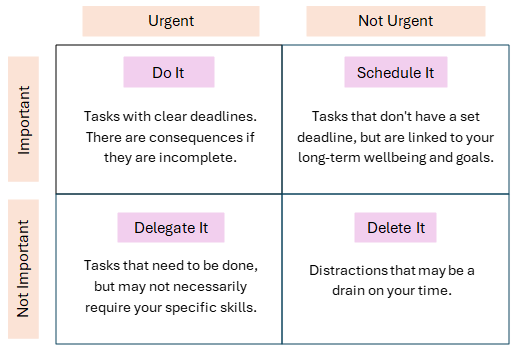
Remember, the matrix isn’t meant to maximise productivity, but to help you decide what truly deserves your limited time and energy.
Alongside tools like this, it can help to:
Plan in broad time blocks rather than minute-by-minute
Leave buffer time between tasks
Treat plans as flexible guides, not tests you can fail
Ψ Practice self-compassion when things don’t go to plan
Some days won’t unfold the way you hoped. How you respond matters.
While self-criticism tends to shut us down, self-compassion empowers us to recalibrate and try again. Speaking to yourself with understanding, rather than blame, supports motivation far more effectively.
A Final Thought
Time management isn’t about squeezing more out of yourself. It’s about shaping a life that reflects what matters to you, through care, intention, and flexibility.
If time feels like a constant source of stress, you’re not failing. You’re human. And with the right support, it’s possible to develop a kinder, more sustainable relationship with time.
