
• About Us
    • Our Team
    • Our Therapeutic Spaces
    • Consultation Fees
    • Careers
    • Understanding Our Professionals
    • List All Clinicians
    • Dr Annabelle
    • Dr Daphne
    • Dr Lidia
    • Dr Yi Ling
    • Dr Nick
    • Angelin
    • Bryce
    • Chen Sung
    • Cherie
    • Christine
    • Cristina
    • Dawn
    • Elysia
    • Haanusia
    • Hui Yu
    • Jeanette
    • Jia Li
    • Jiayong
    • Kingslin
    • Ling Ling
    • Lisa
    • Lynn
    • Max
    • Mira 윤미라
    • Nasriah
    • Shermaine
    • Steph Chan
    • Steph Tak 탁현정
    • Wei Jie
    • Wei Jun
    • Weiting
    • Wendy
    • Yuka ゆか
    • Zack
    • Mental Health Concerns
    • Personality Disorders
    • Women's Health & Fertility
    • Couples and Families
    • Psycho-Legal Service
    • Psychological and Psychometric Assessments
  • Child Psychology
    • Events & Training
    • Schema Therapy Training
    • Corporate Workshops
    • Employee Assistance Programme
    • Media, Clients & Partners
    • Articles & Guides
    • Songs about Mental Health
    • Guided Exercises & Tools
    • Safety Plan
    • Monthly Mental Health Newsletter and Resources
    • FAQ
  • Appointments
  • Sign In My Account
Menu

Annabelle Psychology | Singapore's Leading Psychologists

101 Irrawaddy Road, #17-12
329565
+6582023385
Clinical Psychology

ANNABELLE PSYCHOLOGY

周泳伶临床心理诊所

clinical psychologists

Annabelle Psychology | Singapore's Leading Psychologists

  • Our Clinic
    • About Us
    • Our Team
    • Our Therapeutic Spaces
    • Consultation Fees
    • Careers
    • Understanding Our Professionals
  • Clinicians
    • List All Clinicians
    • Dr Annabelle
    • Dr Daphne
    • Dr Lidia
    • Dr Yi Ling
    • Dr Nick
    • Angelin
    • Bryce
    • Chen Sung
    • Cherie
    • Christine
    • Cristina
    • Dawn
    • Elysia
    • Haanusia
    • Hui Yu
    • Jeanette
    • Jia Li
    • Jiayong
    • Kingslin
    • Ling Ling
    • Lisa
    • Lynn
    • Max
    • Mira 윤미라
    • Nasriah
    • Shermaine
    • Steph Chan
    • Steph Tak 탁현정
    • Wei Jie
    • Wei Jun
    • Weiting
    • Wendy
    • Yuka ゆか
    • Zack
  • Adult Psychology
    • Mental Health Concerns
    • Personality Disorders
    • Women's Health & Fertility
    • Couples and Families
    • Psycho-Legal Service
    • Psychological and Psychometric Assessments
  • Child Psychology
  • Training
    • Events & Training
    • Schema Therapy Training
  • Corporates
    • Corporate Workshops
    • Employee Assistance Programme
    • Media, Clients & Partners
  • Resources
    • Articles & Guides
    • Songs about Mental Health
    • Guided Exercises & Tools
    • Safety Plan
    • Monthly Mental Health Newsletter and Resources
    • FAQ
  • Appointments
  • Sign In My Account

Understanding the Sphere of Concern, Influence and Control  

March 23, 2026 Annabelle Psychology

Turning Worries Into What You Can Actually Influence  

Life can be challenging. We face people, situations, and environments that test our patience, coping capacity, and emotional strength. Yet one of the biggest sources of stress is not the situation itself. It is where we place our focus. 

The idea of the “Sphere of Concern” helps us make sense of our worries, where they come from, and how they affect us, while showing a path towards calm, effective action.  


What Is the Sphere of Concern?  
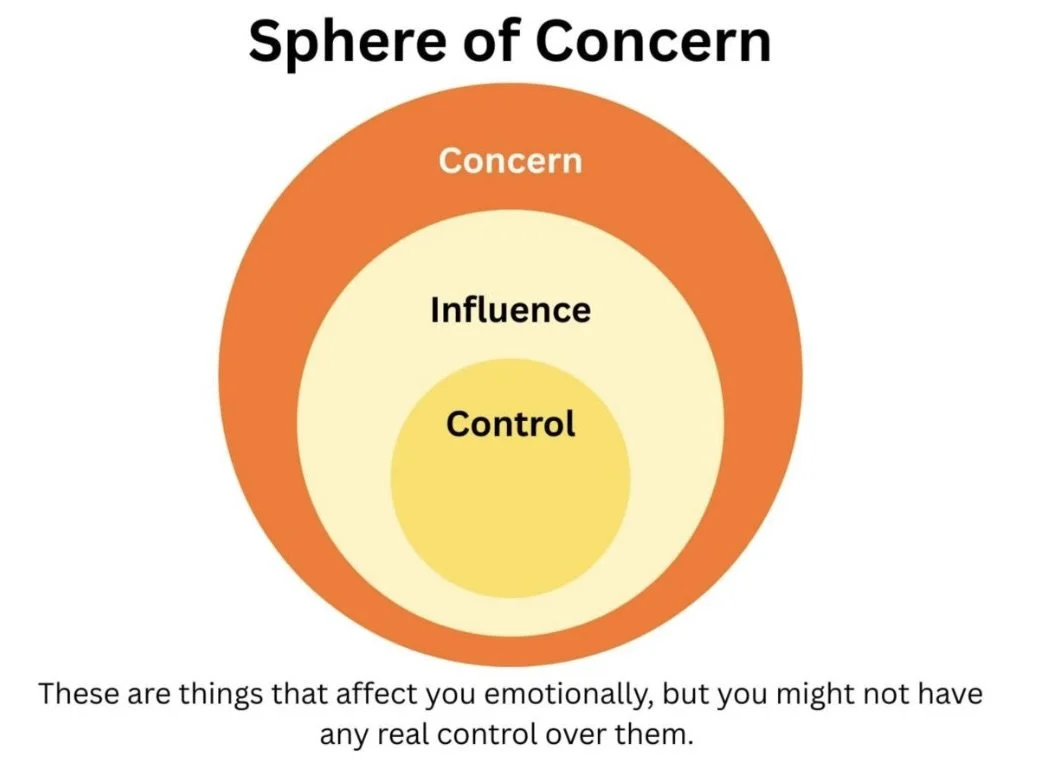
The Sphere of Concern includes everything you care about or worry about, whether you can change it or not.  

It might include things like:  

  • What other people think of you  

  • World events, inequality, climate change  

  • A partner’s thoughts or behaviour  

  • Your past mistakes  

  • Things you wish were different  

These are things that affect you emotionally, but you might not have any real control over them. 

That’s why worrying about them can feel heavy, overwhelming, or stuck.  

Example: 

You might spend hours thinking, “Why did my colleague reply in that tone?” or “What if people think I’m not good enough?”. These thoughts feel urgent, but you cannot directly control another person’s opinions or moods. 


What Is the Sphere of Influence?  
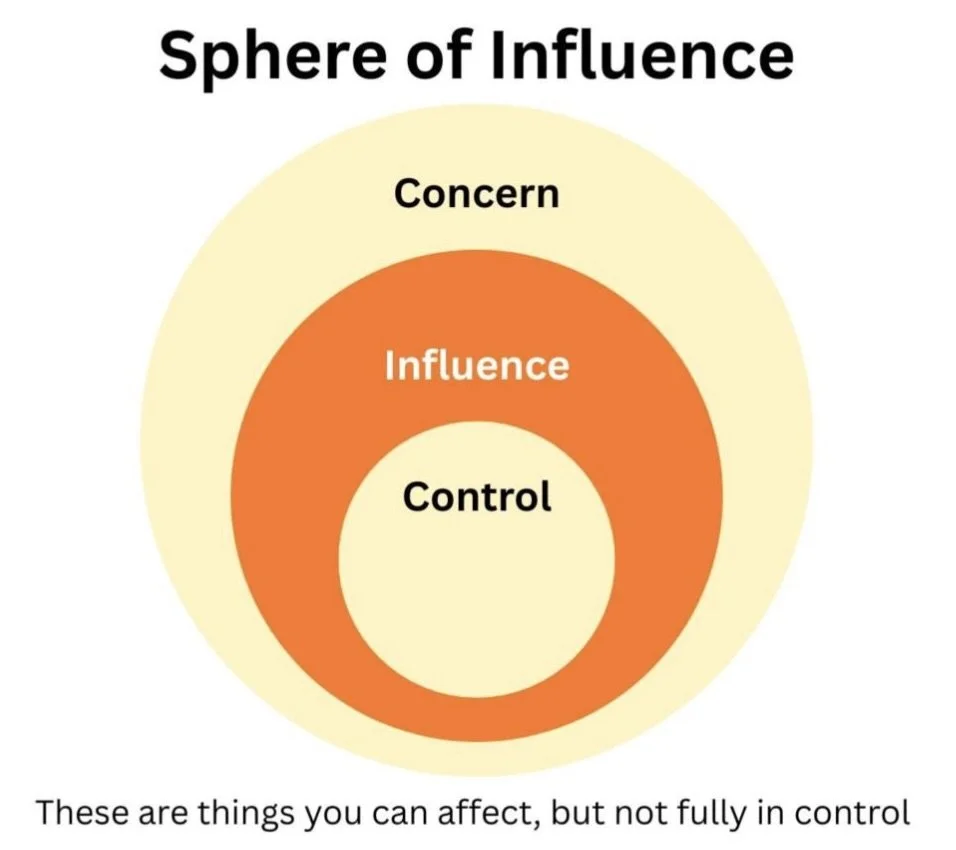
Inside the bigger circle of concern is a smaller circle, the Sphere of Influence. 

Your Circle of Influence includes the things you can actually affect, where your decisions, actions, or mindset matter: 

  • Your daily routines  

  • Your reactions and responses  

  • How you communicate  

  • Healthy habits you choose  

  • Setting boundaries  

  • Asking for help  

When we focus on this smaller, but powerful circle, we build confidence, clarity, and meaningful change.  

Example: 

You cannot control whether your boss is stressed, but you can influence how you respond. You might say, “I just want to check if I understood the task correctly,” instead of assuming criticism and internalising the comments. You may also find it helpful to read the article on Managing a Difficult Boss for ideas on how to navigate your relationship with your boss. 


What Is the Sphere of Control? 
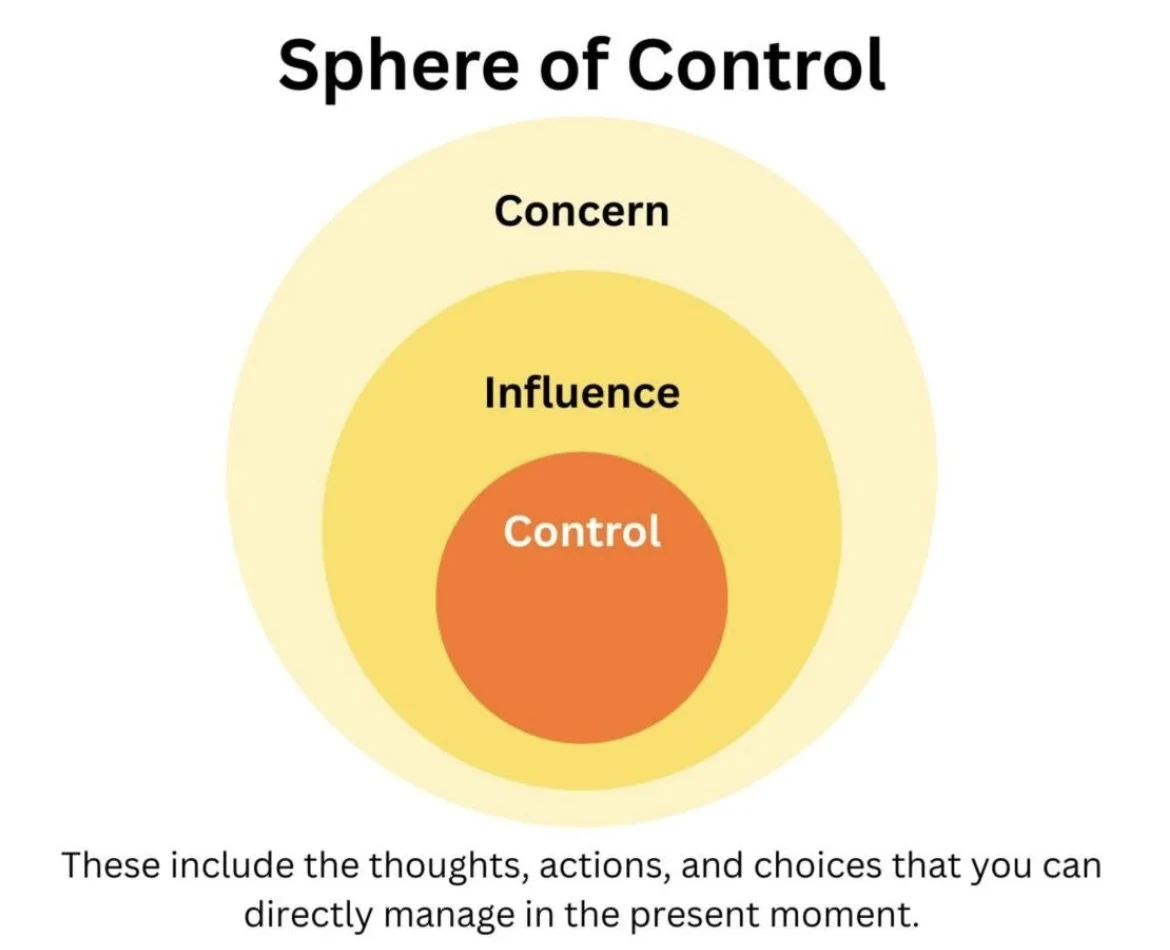
Inside the Sphere of Influence is an even smaller space, the Sphere of Control. 

This is where you have direct choice, right here and now. 

While you may not be able to control other people, the past, or global events, you can control: 

  • Your words 

  • Your actions 

  • Your effort 

  • Your personal values 

  • Your self-care 

  • Your boundaries 

How you choose to respond to difficult emotions 

This is the space of personal responsibility and power. It may seem small, but it is where real change begins. 

Example: 

Instead of saying, “I shouldn’t feel this way,” when you receive critical feedback or an upsetting message, you might tell yourself, “I’m feeling overwhelmed. I can take a breath and slow down.” 


Why It Matters? 

Imagine carrying a backpack full of things you cannot control. That is heavy. 

Now imagine putting into it only things you can do something about. It feels lighter and easier to carry. 

That’s what focusing on influence feels like.  

When we spend most of our energy on things we cannot change, we get:  

  • Anxiety  

  • Frustration  

  • Feeling stuck  

  • Emotional exhaustion  

But when we intentionally focus on what we can influence, we build:  

  • Confidence  

  • Motivation  

  • Greater emotional balance  

  • Real progress  


How to Shift From Concern to Influence 

Here are steps you can use to notice which circle you’re in and bring your attention back to what matters:  

1) Notice Your Worries  

Take a moment to write them down:  

  • “I’m worried about how people see me.”  

  • “I can’t stop thinking about what happened last year.”  

Which of these can you actually control right now? For further guidance, you may also refer to the article on Managing Anxiety, Stressors, and Worries. 


2) Ask Yourself: Can I Influence This?  

Gently categorise each worry:  

Influence  

  • My own reactions  

  • My daily habits  

  • My communication style  

Concern only  

  • What someone else thinks  

  • What happened in the past  

  • Things outside your control  


3) Take Small Steps Inside Your Influence  

Even small actions matter:  

  • Practice a calming routine  

  • Set a boundary  

  • Ask someone for support  

  • Schedule time to rest  

  • Learn a new skill  

Slow, steady focus inside your circle of influence actually expands it over time.  


What This Looks Like in Real Life  

A common example might be:  

Concern: “I’m worried my friend is upset with me.”  
You cannot control how they feel…  

Influence: You can choose how you respond:  

  • Send a caring message  

  • Ask a gentle question  

  • Reflect on your part  

You cannot guarantee their reaction, but you are choosing connection over anxiety. 


A Gentle Reminder  

Focusing on your Circle of Influence does not mean you do not care about the world or other people. It means you are directing your energy where it can actually make a difference, to your wellbeing, relationships, and life. 

You do not have to fix everything. Just what is within reach.   

In Guides & Tips Tags Anxiety & Depression, Coping Strategies, Self-reflection
Mandopop That Feels Like Comfort in Difficult Times →

Annabelle Psychology

Useful Information

Newsroom
Telehealth
Safety Plans
Board of Advisors

Give us Feedback

Clinical Team
Support Team

Clinical Services

Women’s Psychological Health
Couples and Family
Child Psychology
Psycho-legal Service
Psychological & Psychometric Assessments
Employee Assistance Programme


Neurodevelopmental Disorders
Ψ Attention Deficit/Hyperactivity Disorder (ADHD)
Ψ Autism Spectrum Disorder
Ψ Intellectual Disability

Obsessive-Compulsive Disorders

Conduct Disorders
Ψ Conduct Disorder
Ψ Oppositional Defiant Disorder (ODD)

Paraphilic Disorders
Ψ Exhibitionistic Disorder
Ψ Fetishistic Disorder
Ψ Voyeuristic Disorder

Women’s Health
Ψ Endometriosis
Ψ Menopause transition
Ψ Miscarriage & Stillbirth
Ψ Perinatal OCD

Mental Health Concerns

View All

Personality Disorders
Ψ Borderline Personality Disorder (BPD)
Ψ Narcissistic Personality Disorder (NPD)
Ψ Antisocial Personality Disorder

Abuse, Trauma and Stress Disorders
Ψ Abuse and Trauma
Ψ Acute Stress Disorder (ASD)
Ψ Adjustment Disorder
Ψ Complex PTSD
Ψ Post-Traumatic Stress Disorder (PTSD)

Anxiety & Mood Disorders
Ψ Depression
Ψ Social Anxiety Disorder
Ψ Specific Phobias
Ψ Panic Disorder
Ψ Conduct Disorders
Ψ Health Anxiety

Free Mental Health Resources
Understanding the Sphere of Concern, Influence and Control  
Mar 23, 2026
Understanding the Sphere of Concern, Influence and Control  
Mar 23, 2026
Mar 23, 2026
Mandopop That Feels Like Comfort in Difficult Times
Mar 20, 2026
Mandopop That Feels Like Comfort in Difficult Times
Mar 20, 2026
Mar 20, 2026
High-Functioning Depression: Signs and Support
Mar 20, 2026
High-Functioning Depression: Signs and Support
Mar 20, 2026
Mar 20, 2026
Panic Attacks: What’s Happening in Your Body and How to Respond
Mar 16, 2026
Panic Attacks: What’s Happening in Your Body and How to Respond
Mar 16, 2026
Mar 16, 2026
OPM Songs for Healing, Hope, and Hard Days
Mar 14, 2026
OPM Songs for Healing, Hope, and Hard Days
Mar 14, 2026
Mar 14, 2026
A Guide to Coping with Friendship Breakup
Mar 13, 2026
A Guide to Coping with Friendship Breakup
Mar 13, 2026
Mar 13, 2026
How to Manage Panic Attacks
Mar 9, 2026
How to Manage Panic Attacks
Mar 9, 2026
Mar 9, 2026
How to Support a Loved One Who’s Been Through Trauma
Mar 6, 2026
How to Support a Loved One Who’s Been Through Trauma
Mar 6, 2026
Mar 6, 2026
Why Manage Anger? How It Affects Your Wellbeing.jpg
Mar 4, 2026
Why Manage Anger? How It Affects Your Wellbeing
Mar 4, 2026
Mar 4, 2026
7 Simple Ways to Relax When Life Feels Like Too Much 
Mar 2, 2026
7 Simple Ways to Relax When Life Feels Like Too Much 
Mar 2, 2026
Mar 2, 2026
More Than Skin Deep: Understanding Self-Harm
Feb 27, 2026
More Than Skin Deep: Understanding Self-Harm
Feb 27, 2026
Feb 27, 2026
 Low Sexual Desire: When Intimacy Feels Hard to Talk About 
Feb 25, 2026
 Low Sexual Desire: When Intimacy Feels Hard to Talk About 
Feb 25, 2026
Feb 25, 2026
How to Heal After a Breakup: Gentle Tips for Heartbreak
Feb 23, 2026
How to Heal After a Breakup: Gentle Tips for Heartbreak
Feb 23, 2026
Feb 23, 2026
Time Management Tips for Stress, Overwhelm and Burnout
Feb 20, 2026
Time Management Tips for Stress, Overwhelm and Burnout
Feb 20, 2026
Feb 20, 2026
Why Do I Feel Angry All the Time: Understanding Anger
Feb 16, 2026
Why Do I Feel Angry All the Time: Understanding Anger
Feb 16, 2026
Feb 16, 2026
A Gentler Way to Communicate: Using ‘I’ Statements
Feb 13, 2026
A Gentler Way to Communicate: Using ‘I’ Statements
Feb 13, 2026
Feb 13, 2026
Managing a Difficult Boss: How to Cope at Work
Feb 9, 2026
Managing a Difficult Boss: How to Cope at Work
Feb 9, 2026
Feb 9, 2026
Sleep Hygiene Basics: 7 Key Principles for Better Sleep 
Feb 6, 2026
Sleep Hygiene Basics: 7 Key Principles for Better Sleep 
Feb 6, 2026
Feb 6, 2026
Grief Rituals: Finding Structure in Loss
Feb 2, 2026
Grief Rituals: Finding Structure in Loss
Feb 2, 2026
Feb 2, 2026
How to Practise Abdominal (Belly) Breathing 
Jan 26, 2026
How to Practise Abdominal (Belly) Breathing 
Jan 26, 2026
Jan 26, 2026
The Male Loneliness Epidemic: Why More Men in Singapore Are Feeling Isolated Today
Dec 29, 2025
The Male Loneliness Epidemic: Why More Men in Singapore Are Feeling Isolated Today
Dec 29, 2025
Dec 29, 2025
Understanding Premature Ejaculation - When It Happens Too Soon
Dec 22, 2025
Understanding Premature Ejaculation - When It Happens Too Soon
Dec 22, 2025
Dec 22, 2025
How to Cope When Traumatic News Leaves You Shaken
Dec 19, 2025
How to Cope When Traumatic News Leaves You Shaken
Dec 19, 2025
Dec 19, 2025
Understanding Erectile Dysfunction: It’s More Common Than You Think
Dec 15, 2025
Understanding Erectile Dysfunction: It’s More Common Than You Think
Dec 15, 2025
Dec 15, 2025
How Hormonal Shifts Shape Men’s Emotional Wellbeing
Dec 8, 2025
How Hormonal Shifts Shape Men’s Emotional Wellbeing
Dec 8, 2025
Dec 8, 2025
Men and Body Image: Why It’s Time to Talk About It
Dec 1, 2025
Men and Body Image: Why It’s Time to Talk About It
Dec 1, 2025
Dec 1, 2025
How to Cope with Sexual Performance Anxiety
Nov 24, 2025
How to Cope with Sexual Performance Anxiety
Nov 24, 2025
Nov 24, 2025
 Body Dysmorphic Disorder (BDD): Why It’s Not Vanity
Nov 17, 2025
Body Dysmorphic Disorder (BDD): Why It’s Not Vanity
Nov 17, 2025
Nov 17, 2025
Hyperemesis Gravidarum: More Than Just Morning Sickness
Nov 10, 2025
Hyperemesis Gravidarum: More Than Just Morning Sickness
Nov 10, 2025
Nov 10, 2025
Andropause Is Real: Understanding the Emotional Toll of Low Testosterone
Nov 3, 2025
Andropause Is Real: Understanding the Emotional Toll of Low Testosterone
Nov 3, 2025
Nov 3, 2025

Free Monthly Resource

Subscribe to receive our curated mental health resource

You can unsubscribe at any time.

Thank you for signing up for our Newsletter.

Check your e-mail for our next toasty newsletter soon!

View our Newsletter Archive here

Proudly Supporting Inclusive Communities

Annabelle Psychology's Company of Good 1 Heart

Company of Good

SG Enable Enabling Employment Pledge

SG Enable

PAP Mental Health Group logo

PAP Mental Health Group Community Partner


Psychologists


Dr Annabelle Chow
Dr Daphne Goh
Dr Lidia Suárez
Dr Yi Ling Tay
Dr Nick Buckley
Angelin Truscott
Bryce Ong
Chen Sung Wong
Cherie Sim
Christine Kwek
Cristina Gwynn
Dawn Chia
Elysia Tan
Haanusia Raj
Hui Yu Chan
Jeanette Lim
Jia Li Lim
Jiayong Lin
Kingslin Ho
Lisa Tang
Lynn Ng
Maximillian Chen
Nasriah Rizman
Shermaine Chek
Stephanie Chan
Stephanie Tak
Wei Jie Soh
Wei Jun Tan
Weiting Zeng
Yuka Aiga
Zack Yeo

Allied Health Practitioners


Couple and Family Counsellors
Ling Ling Chiam
Wendy Yeap

Art Therapists
Mira Yoon

Speech Therapists
Anabella Seah

Occupational Therapists
Akio Lim
Sharyn Koh

Make an Appointment with our Clinicians

Consultations

Strictly by appointment only

Operating Hours:
Monday to Saturday, 8.00 am to 6.00pm

enquiries attended from 9:00am except After Hours

Rates

Consultations after 6.00pm, or on Saturdays, Sundays, or the eve of or on Public Holidays, attract an additional fee (“After Hours“). Rates here.

Different rates apply to outcalls, couple, family, diagnostics and other services.

Contact

+65 8202 3385
appointments@apsy.sg

Novena

Annabelle Psychology (Novena)
Royal Square Medical Centre
101 Irrawaddy Road #17-12
Singapore 329565

Thomson

Annabelle Psychology (Thomson)
SLF Building
510 Thomson Road #15-03
Singapore 298135


Careers | Terms | Payment
All rights reserved © 2024