• About Us
    • Our Team
    • Our Therapeutic Spaces
    • Consultation Fees
    • Careers
    • Understanding Our Professionals
    • List All Clinicians
    • Dr Annabelle
    • Dr Daphne
    • Dr Lidia
    • Dr Yi Ling
    • Dr Nick
    • Angelin
    • Bryce
    • Chen Sung
    • Cherie
    • Christine
    • Cristina
    • Dawn
    • Elysia
    • Haanusia
    • Hui Yu
    • Jeanette
    • Jia Li
    • Jiayong
    • Kingslin
    • Ling Ling
    • Lisa
    • Lynn
    • Max
    • Mira 윤미라
    • Nasriah
    • Shermaine
    • Steph Chan
    • Steph Tak 탁현정
    • Wei Jie
    • Wei Jun
    • Weiting
    • Wendy
    • Yuka ゆか
    • Zack
    • Mental Health Concerns
    • Personality Disorders
    • Women's Health & Fertility
    • Couples and Families
    • Psycho-Legal Service
    • Psychological and Psychometric Assessments
  • Child Psychology
    • Events & Training
    • Schema Therapy Training
    • Corporate Workshops
    • Employee Assistance Programme
    • Media, Clients & Partners
    • Articles & Guides
    • Songs about Mental Health
    • Guided Exercises & Tools
    • Safety Plan
    • Monthly Mental Health Newsletter and Resources
    • FAQ
  • Appointments
  • Sign In My Account
Menu

Annabelle Psychology | Singapore's Leading Psychologists

101 Irrawaddy Road, #17-12
329565
+6582023385
Clinical Psychology

ANNABELLE PSYCHOLOGY

周泳伶临床心理诊所

clinical psychologists

Annabelle Psychology | Singapore's Leading Psychologists

  • Our Clinic
    • About Us
    • Our Team
    • Our Therapeutic Spaces
    • Consultation Fees
    • Careers
    • Understanding Our Professionals
  • Clinicians
    • List All Clinicians
    • Dr Annabelle
    • Dr Daphne
    • Dr Lidia
    • Dr Yi Ling
    • Dr Nick
    • Angelin
    • Bryce
    • Chen Sung
    • Cherie
    • Christine
    • Cristina
    • Dawn
    • Elysia
    • Haanusia
    • Hui Yu
    • Jeanette
    • Jia Li
    • Jiayong
    • Kingslin
    • Ling Ling
    • Lisa
    • Lynn
    • Max
    • Mira 윤미라
    • Nasriah
    • Shermaine
    • Steph Chan
    • Steph Tak 탁현정
    • Wei Jie
    • Wei Jun
    • Weiting
    • Wendy
    • Yuka ゆか
    • Zack
  • Adult Psychology
    • Mental Health Concerns
    • Personality Disorders
    • Women's Health & Fertility
    • Couples and Families
    • Psycho-Legal Service
    • Psychological and Psychometric Assessments
  • Child Psychology
  • Training
    • Events & Training
    • Schema Therapy Training
  • Corporates
    • Corporate Workshops
    • Employee Assistance Programme
    • Media, Clients & Partners
  • Resources
    • Articles & Guides
    • Songs about Mental Health
    • Guided Exercises & Tools
    • Safety Plan
    • Monthly Mental Health Newsletter and Resources
    • FAQ
  • Appointments
  • Sign In My Account

Women and Mental Health

June 21, 2022 Dr Annabelle

Among the UN nations, only 11 nations had a female head of state while 12 nations had a female head of government (we suspect most of these nations are headed by - deep breath - Her Majesty The Queen Elizabeth the Second, by the Grace of God, of the United Kingdom of Great Britain and Northern Ireland and of her other realms and territories Queen, Head of the Commonwealth, Defender of the Faith; by contrast, the head of government in a commonwealth country will usually be the Prime Minister - to continue the analogy, this would be The Right Honourable Boris Johnson MP, Prime Minister).

In Parliament (including the Singapore Parliament), women parliamentarians constitute approximately 20% of the parliament. Within the workforce, women account for less than a quarter of senior roles globally and the gender pay gap persists around the world.

There’s no denying it. Gender bias permeates through every aspect of our lives: at home and at the work place. Even in medical settings, especially when clinical judgment is involved.

For example, depression is one of the most common mental illnesses in the world, but it is almost twice as common in women than men. Women are also the single largest group of people affected by Post-Traumatic Stress Disorder (PTSD).

Reasons for this gender disparity may include gender-based risk factors, such as domestic violence, socio-economic disadvantages, income disparities or inequalities, differences in social standing or empathy for others, all disproportionately affect women. Of course, other factors such as how symptoms are differently perceived and diagnosed in women and men also come into play.

Can we reduce the risk of developing mental illness in women?

Yes! Research shows that there are 3 main factors that are highly protective against the development of mental disorders (in men or women) arising from severe or traumatic events:

Ψ Having sufficient autonomy to exercise control over your actions after the event
Ψ Resources to allow the making of informed choices
Ψ Support from family, friends, and psychological support from mental health professionals

More is needed to reduce the risk of women developing mental illnesses such as depression. Changes are needed as a society to ensure that women have autonomy and equal access to resources and essential services; basically, we must improve the protective factors against the development of mental illnesses in women.

As persons – employers, co-workers, friends, or family members – we must all do our part to address personal biases, acknowledge and respect “the other half” of humanity.

In Women's Health Tags Coping Strategies

The Authentic Self

June 21, 2022 Annabelle Psychology

Are we truly living happy lives?

You've seen glamorous pictures of their cars, watches, and handbags (and other things from www.uncrate.com - which by the way is an excellent site to while away the time).

Or perhaps watched the latest 'stories' of linen-clad ‘frienemies’ traversing the Moroccan plains atop a camel. Maybe nothing too rich, just a good-looking former colleague armed with her silky-haired squad hitting the clubs every weekend, and you look at yourself, slumped on the couch with a bag of potato chips watching Netflix (or worse, endlessly scrolling through for something to watch).

Yep. We've all seen these pictures and most of us are guilty of it.

Social media platforms such as Facebook and Instagram inadvertently foster comparisons with your peers. You think, “Why can’t my life be as fun and exciting?” And you start to make plans to skip lunches to save up for a holiday to take twice as many photos, with your new skinny body of course. Or you blow your bonus on that much-vaunted 2.55 alligator bag in gold.

But still we constantly scroll through our feeds looking at the polished pictures of our peers. The cycle (and the feed) is endless.

Why?

Like Thanos, we want to reshape reality. We want to convince our friends and family that we are a certain person whether or not that might be true. We might even believe that we are the image that we create for ourselves. In a world of smartphones and selfies, where our identities are equated with our social media profiles, who’s to know what we are or aren’t?

But are we truly living happy lives?

A study conducted in 2015 found a strong correlation between authenticity and self-esteem. People felt better about themselves if they believed they were living authentic lives; if they thought they were true about themselves.

What is an authentic life? One philosopher thought an authentic life involved making choices based on your own values, rather than in accordance with the values of anyone else.

But almost every photograph on Facebook or Instagram is a filtered version of reality – there literally are dozens of filters to choose from to edit a photograph. They are also filtered because people only want the positive on display. Perhaps what wasn’t shown to you was how disastrously smelly that Moroccan camel was, how many times she puked along Jiak Kim Street after Mambo Night, or how many installments are left on that BMW. Our quest to emulate the lives of these people becomes meaningless because the very thing we seek to recreate is not real.

We would all be a lot happier (and richer) if we stopped trying to live like the people we follow on social media. Live life on our own terms, simply and without reference to others (said no professor ever).

In the wise words of Heidegger the philosopher, “The path we follow is always of our own choosing. We should never allow our fears or the expectations of others to set the frontiers of our destiny.”

In Guides & Tips Tags Self-reflection

Dealing with Shame

June 23, 2020 Dr Annabelle

“Shame is a way of life here. It’s stocked in the vending machines, stuck like gum under the desks, spoken in the morning devotionals. She knows now that there’s a bit of it in her.”

- Casey McQuiston

On a scale of 1-10, how true do the following 3 statements feel?

  1. ‘I am a mistake’

  2. ‘I am defective’

  3. ‘I am unworthy of being loved’

Any score above 8 starts to indicate the problem of shame. Though to be fair, people who are disproportionately ashamed of who they are would have probably wanted to award themselves a thousand more.


What is Shame?

In shame, the focus of attention is on the “bad” self. Shame is a family of unpleasant self-conscious emotions that include embarrassment, guilt and humiliation, which makes us feel awful about ourselves.

Imagine tripping down the stairs and falling face-first onto the ground in a shopping center. Why was your initial thought ‘Did anyone see that?’ instead of tending to your agonizing physical pain first?

Shame is always present in our lives. We are motivated to maintain and achieve a positive sense of ourselves.

The issue with shame comes with a tendency to hide these negative emotions. Who likes to openly humiliate themselves? This makes it hard to recognize shame when it happens. For example, adolescents may superficially laugh off a poor exam result together while privately experiencing tremendous feelings of anxiety about failure.

As we avoid talking about our feelings of shame, we continue to have a lack of understanding about it.

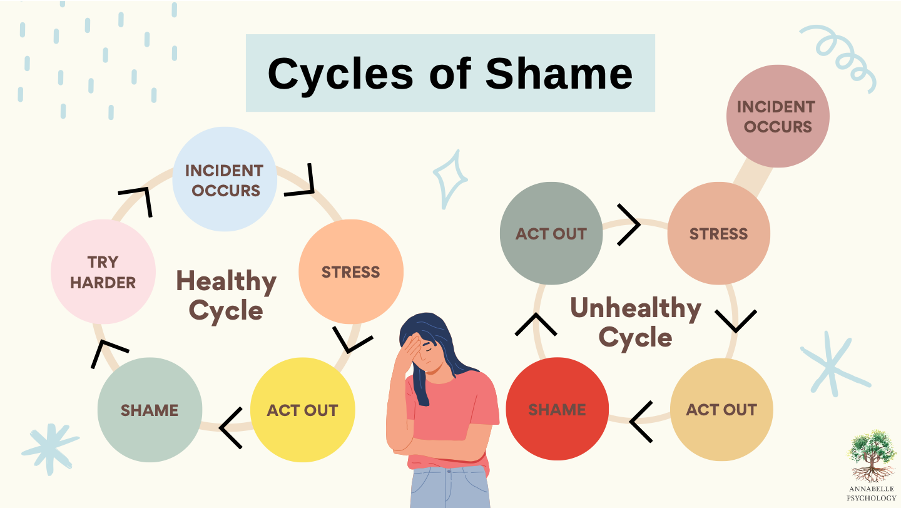
Comparing the Cycles of Shame: Healthy vs Unhealthy


Let us work together to understand the diagram of a typical circumstance for a healthy shame cycle (see diagram on the left). Imagine being called out or reprimanded in a group chat by your manager for a serious error you made at work. You start to feel psychologically stressed as your heart begins to beat faster, your palms sweat, and your cheeks flush with embarrassment. You feel ashamed of your mistakes as you worry about being judged poorly by your coworkers. To alleviate these unpleasant emotions of shame, you are driven to strive more in the future to avoid repeating the same mistake.

Unfortunately, this is not the case for those who struggle with shame (see diagram on the right). Replaying the same event above, instead of trying harder to lessen the feelings of shame, you find yourself in an unhealthy spiral. By having excessive self-critical thoughts, or even indulging in self-destructive behaviours, you inadvertently feed these shameful emotions. You begin to mistakenly ascribe your mistake to a dispositional problem that only arises due to your lack of skill, causing you to get stressed once again.

It is essential to deal with the unhealthy shame cycle as excessive feelings of shame can lead to serious mental health problems. Some of the negative consequences of toxic shame include:

  • Fear of letting people in

  • Excessively pushing people away

  • Feelings of embarrassment and/or humiliation

  • Low self-esteem

  • Lack of empathy for others

  • Cynical thoughts about the future (e.g., believing that bad things happen to bad people)

  • Obsessive rumination on self-critical thoughts (e.g., ‘I am unworthy of being loved’)

  • Self-destructive/Addictive behaviours (e.g., substance use, self-harm and suicide)

Overcoming Shame

One way to overcome the problem of shame is from an Acceptance and Commitment Therapy (ACT) approach. ACT is a psychological intervention that involves accepting and embracing life events as they are without seeking to change them. It also involves committing to making meaningful steps to improve and enhance your life.

Before we dive deeper into ACT, we need to first understand how an unhealthy shame cycle forms and takes root.

As you get older, you start to develop a better understanding of how your actions affect others through learning from your mistakes. Parents hold an important responsibility to remind you that mistakes are normal. We can use the lessons we have learned from our failures to make better decisions in the future.

However, instead of guiding children through their mistakes, parents may unintentionally send unhelpful messages to the child. They may do so by expressing criticism and/or disappointment directed at the child rather than their conduct:

“Can you stop being the laziest child in the house and do some chores?”
“You just had to be the only student in class to fail that test.”
“Stop embarrassing me and behave yourself.”

This may give the child the false idea that he or she is undeserving of affection, which can lead to shame. Unhealthy shame thus prevents a more positive perspective of oneself, making it difficult for the child to develop a healthy sense of self-worth.

Let’s now look at how the ACT’s 6 key processes can help you overcome shame:


(1)  Acceptance

When we are overwhelmed with unwanted feelings of shame, it is instinctive for us to try to avoid and suppress them. Acceptance, on the other hand, is acknowledging and embracing the portion of yourself that feels “not good enough”, “unlovable” and/or “rejected”. 

Do not get us wrong, acceptance does not mean that you are inviting or seeking feelings of shame. After all, who likes to dwell in their misery? Acceptance simply makes room to experience the agony of shameful emotions.

Soon, you will quickly notice that you are less disturbed by these feelings of shame if you do not attempt to escape from them. Isn’t it funny? The more you want to embrace and accept your shame, the less salient they become.


(2)  Cognitive Defusion

“I am unlovable at home.” “I am not good enough at my workplace.”

These are some common self-criticizing thoughts from someone struggling with shame. Cognitive defusion involves establishing a psychological distance from these self-defeating beliefs, understanding that they are just one of many non-threatening perspectives.

To do so, start by asking yourself this question: Who will have control over your life – you or your mind? Choosing a different relationship with your problematic thoughts allows you to take a step back and not be consumed by them.

For instance, you can recognize a mistake you made at work as it is without attributing them as part of your personality.


(3)  Being Present

Take a trip back home from work or school with me. What do you usually do on the train/bus/walk back home? Are you consumed by social media on your phone? Or maybe you are planning ahead of time on how you are going to rest at home? Notice how none of these options include spending intentional time in the present.

Being in contact with the present moment is also known as “being in the now”. It involves focusing on what is happening to you, and/or in your environment at the present moment rather than on what has happened in the past or what may happen in the future.

When you are faced with feelings of shame, fully embrace them first! Then, acknowledge that past events are irreversible. Although you could have responded better, understand that you cannot change the past. Making mistakes is what makes us human!

When you start to focus more on the present, you spend less time evaluating and criticizing yourself and others.


(4)  The Observing Self

If we are being honest, we sometimes feel ashamed of ourselves in certain situations because we project our worries or past experiences onto the current situation. However, we fail to see that most of these assumptions are irrational and therefore our interpretation of such occurrences is often incorrect.

Hence, the next phase is observing and knowing yourself as part of a context. Think of this phase as objectively looking at your situation from an observer’s point of view. Refrain from allowing your thoughts and feelings to cloud your judgment on the situation.

This is realizing that your thoughts and feelings are a result of the situation, not of your personality. You can experience feelings of shame but you are NOT defined by them!


(5)  Values – What matters to you? 

Whether you recognize them or not, everyone has values. Values are qualities that you believe are the most important. They determine your priorities, guide your personal growth and help you make decisions about how you want to live your life.

The issue with our values is that we are not constantly in touch with them. When life gets in the way, we might lose track of them and become unsure of what they are. This causes our values to become more vulnerable and susceptible to change.

What used to be unimportant to you such as fear of judgment or embarrassment could have unconsciously become your most important value over time.

Hence, we encourage you to take some time to consider:

1)    What are the things that are most important to you?

2)    How would you like to be remembered?

3)    What are the things you strongly object to?

Our values need to be sorted out first before we can come up with a plan to challenge your feelings of shame.


(6)  Taking Committed Actions

Now that you have learned to embrace the unwanted feelings of shame and developed a clearer sense of values you wish to live by, we have now come to the final step of overcoming shame – taking committed actions. This is where you take concrete actions and behave in ways that lead to positive changes in your life.

There are many ways you can do this depending on what you are struggling with. For instance, you can set goals that are in line with your values and beliefs. You could even intentionally expose yourself to difficult thoughts or experiences.

Consistently practice and commit to those behaviours to achieve the goals that you have set out. The key to taking committed actions is to incorporate changes in your life that will align with your established values.

A Final Piece of Advice

We should stress that every human being is radically imperfect and broken in their own way. It’s okay to accept your flaws as everyone has them. Remind yourself that no one is perfect! If you feel comfortable enough, find a friend whom you trust and share your feelings of shame with them. We are positive that they will be more than happy to listen to your struggles!

In Guides & Tips Tags Coping Strategies

Needs vs Expectations

January 7, 2020 Annabelle Psychology

Is it a need or a want?

What are Needs?

As the word suggests, Needs are not merely desirable to have, but are absolutely necessary for our well-being and growth. Despite their importance, they remain an elusive concept that is difficult to define.

When is a need a Need, or merely a Want?

Though much ink has been spilt over its definition and which model of needs truly describe the human condition, no explanation is perhaps more ubiquitous than Maslow’s Hierarchy of Needs. Maslow’s model describes the five fundamental of needs arranged in a hierarchy. The hierarchy ranks the needs in levels of priority in the following order of importance: Physiological, Safety, Love and Belonging, Esteem, and Self-actualisation. Each level is predicated upon the previous level (i.e. each level is built upon the previous one). You can read more about what each level means here. (If you want to explore an alternative model, see the McClelland’s Three Needs Theory)

No matter which model or theory you prefer, Needs play a central role in our daily lives by giving us purpose and directing our behaviours towards a goal.

For example, at Annabelle Psychology (and we suspect many of you as well), food remains an imperative need. Food literally drives our daily behaviour.


But of course, beyond physiological needs, we also have other needs. Psychological needs such as the desire to form good interpersonal relationships, or to achieve a certain standing or status in society, also influence our behaviour. Together, our collection of needs reflects our basic physical needs (e.g., sustenance and shelter) and the higher values that speak to our very being, such as self-actualisation—the realisation of one’s full potential.

The effects of an unmet need can range from the debilitating to the downright devastating. For example, something seemingly trivial such as social rejection has the potential to impair intellectual performance or even lead to poor impulse control.

Great Expectations (also known as Wants)

“Human wants are unlimited”

— Alfred Marshall

Expectations are standards we uphold for ourselves or others, or other aspects of life like work, or of the future. These may or may not be realistic.

It is often our wants or expectations, especially the unrealistic or uncommunicated ones, that leave us feeling unfulfilled or dissatisfied with life.

Our expectations, and the effect that these will have on others, affect how we interact with others, and how others react to us.

“How?”, you may ask?

For starters, it is possible that we do not even realise that we have these expectations or wants to begin with, or how strongly we actually feel about a particular want. That is, of course, until we eventually find ourselves feeling frustrated and upset over an unmet want.

Even when we are aware of our expectations, we may choose to conceal them out of fear that we will be rejected or let down by others. However, those around you may eventually come to know of your expectations - whether through purposeful or inadvertent verbal or non-verbal cues, and respond accordingly. Depending on the response, we may find ourselves steeped in sadness or disappointment.

Furthermore, we may become overly attached to desired outcomes, even if they are unrealistic. In such cases, our expectations, or standards, that we impose on others to achieve those outcomes may launch us into a vicious (and difficult to break out of) cycle of disappointment and resentment that sours relationships.

If we can calibrate our expectations and wants to only realistic and unhelpful ones, and communicate these in an effective but honest manner, we can save ourselves a lot of stress and eliminate a major obstacle in the way of prioritising our fundamental needs.

At the end of the day, we must strive to be completely honest with ourselves in distinguishing between our wants and needs.

Three Golden Rules that may be helpful when attempting to distinguish between Needs and Wants:

  1. Why do I “need” this?

  2. Can I afford it? (whether in terms of money, commitment, or energy)

  3. If I did not see this, would I still “want” it? (will I be okay without it)

In Guides & Tips Tags Self-reflection

Why It’s Okay to Fall in Love With Your Therapist

September 18, 2019 Annabelle Psychology

“What if I fall in love with my therapist?”

Client-Therapist Relationship

The client-therapist relationship is a special one.

For the therapist, the nature of each relationship is professional but for each individual client, highly personal and vulnerable.

Guided by the therapist, each client places him or herself into a vulnerable position where they truthfully bare their thoughts, feelings and emotions. The therapist must carve out an empathetic and nurturing space for each client to be frank yet safe. This process is part of what we call a therapeutic alliance – that special relationship between client and therapist where both parties work towards a common goal in therapy. For therapy to be effective, this therapeutic alliance must be empathetic, genuine, insightful, and judgment-free.

Unlike other personal relationships, the one we form with our psychologist is incredibly unique as it is a one-sided, time-sensitive relationship. The client shares deeply personal information, while the psychologist does not. A therapist might, under rare circumstances, engage in limited self-disclosure as deemed necessary or appropriate and only as part of a therapeutic purpose.

Professional Ethics in Psychology

Due to the professional nature of the relationship, there exists a power imbalance between a psychologist and client.

Unethical therapists might take advantage of the relationship dynamics and unduly influence their clients in impermissible ways. Such impermissible conduct include forming dual relationships, engaging in romantic or sexual intimacy with the client or their close relatives or significant others.

Psychologists are expected to adhere to a strict code of ethics set out by their professional organisations to ensure that these boundaries are respected.

If you feel like your psychologist is crossing any of these boundaries, it is important that you speak up.

Why do we fall in love with our therapist?

Often times, a client subconsciously projects their feelings and emotions onto their psychologist.

This is also known as transference, a phenomenon where the client experiences emotions, be it negative or positive, romantic or sexual, directed towards their psychologist. Transference is neither shameful nor uncommon, and actually occurs rather often in therapy!

Transference occurs when feelings towards another individual in the client’s life is misdirected towards the psychologist. In therapy, the psychologist processes transference with the client to allow the client to better understand the underlying causes for these emotions.

Countertransference may also be experienced in the other direction, which occurs when a psychologist becomes emotionally involved with their clients. Psychologists are trained to detect and manage countertransference, including referring clients to other psychologists if necessary.

Another reason why we might fall in love with our psychologist is the amount of time spent together in what might be described as an emotionally intimate setting. Therapy often occurs across several sessions regularly and frequently. Clients can often spend a large amount of time with their psychologist and have associated the time spent together as a safe space. The psychologist creates a welcoming and non-judgmental space for clients to freely share their thoughts and feelings in a warm and validating environment. This is to encourage the client to be open in sharing about the struggles they are having, which enhances the effectiveness of therapy. During therapy, the client talks about topics intimate to them, and while not necessarily romantic in nature, but deeply personal conversations that they might not disclose to others. This creates a bond with the psychologist that is intimate and can might be sometimes mistaken for a romantic connection.

What happens if I fall in love with my therapist?

Fret not, as mentioned earlier, this occurs far more often we think!

Firstly, if you suspect that you are having feelings towards your psychologist, it is important to examine those feelings and acknowledge them. Whenever you feel ready and comfortable, share your feelings with your psychologist. Acknowledging and sharing your feelings is part of and beneficial to the therapeutic process. As these feelings might be a product of transference, unpacking them with your psychologist might allow you to progress in therapy by discovering patterns about yourself, allowing you to progress further on your journey!

Your psychologist will set clear boundaries with you as guided by their code of ethics. Your psychologist is not permitted to reciprocate your feelings as they are not ethically appropriate within the boundaries of a healthy therapeutic relationship. They will also make a professional judgment if your feelings are affecting therapeutic progress and if a transfer to another psychologist is necessary. This is done in your best interest as your feelings might lead to subconscious biases or countertransference.

Ultimately, having feelings towards your psychologist is not necessarily a negative thing. It certainly is understandable if it occurs, and can even be beneficial to the client as well! After all, love is confusing but has the potential to make us better.

Psychologists adhere to the applicable Code of Ethics of their respective professional bodies in Australia, Singapore, or elsewhere.

In Therapy Approaches
← Newer Posts

Annabelle Psychology

Useful Information

Newsroom
Telehealth
Safety Plans
Board of Advisors

Give us Feedback

Clinical Team
Support Team

Clinical Services

Women’s Psychological Health
Couples and Family
Child Psychology
Psycho-legal Service
Psychological & Psychometric Assessments
Employee Assistance Programme


Neurodevelopmental Disorders
Ψ Attention Deficit/Hyperactivity Disorder (ADHD)
Ψ Autism Spectrum Disorder
Ψ Intellectual Disability

Obsessive-Compulsive Disorders

Conduct Disorders
Ψ Conduct Disorder
Ψ Oppositional Defiant Disorder (ODD)

Paraphilic Disorders
Ψ Exhibitionistic Disorder
Ψ Fetishistic Disorder
Ψ Voyeuristic Disorder

Women’s Health
Ψ Endometriosis
Ψ Menopause transition
Ψ Miscarriage & Stillbirth
Ψ Perinatal OCD

Mental Health Concerns

View All

Personality Disorders
Ψ Borderline Personality Disorder (BPD)
Ψ Narcissistic Personality Disorder (NPD)
Ψ Antisocial Personality Disorder

Abuse, Trauma and Stress Disorders
Ψ Abuse and Trauma
Ψ Acute Stress Disorder (ASD)
Ψ Adjustment Disorder
Ψ Complex PTSD
Ψ Post-Traumatic Stress Disorder (PTSD)

Anxiety & Mood Disorders
Ψ Depression
Ψ Social Anxiety Disorder
Ψ Specific Phobias
Ψ Panic Disorder
Ψ Conduct Disorders
Ψ Health Anxiety

Free Mental Health Resources
Why Do I Feel Angry All the Time: Understanding Anger
Feb 16, 2026
Why Do I Feel Angry All the Time: Understanding Anger
Feb 16, 2026
Feb 16, 2026
A Gentler Way to Communicate: Using ‘I’ Statements
Feb 13, 2026
A Gentler Way to Communicate: Using ‘I’ Statements
Feb 13, 2026
Feb 13, 2026
Managing a Difficult Boss: How to Cope at Work
Feb 9, 2026
Managing a Difficult Boss: How to Cope at Work
Feb 9, 2026
Feb 9, 2026
Sleep Hygiene Basics: 7 Key Principles for Better Sleep 
Feb 6, 2026
Sleep Hygiene Basics: 7 Key Principles for Better Sleep 
Feb 6, 2026
Feb 6, 2026
Grief Rituals: Finding Structure in Loss
Feb 2, 2026
Grief Rituals: Finding Structure in Loss
Feb 2, 2026
Feb 2, 2026
How to Practise Abdominal (Belly) Breathing 
Jan 26, 2026
How to Practise Abdominal (Belly) Breathing 
Jan 26, 2026
Jan 26, 2026
The Male Loneliness Epidemic: Why More Men in Singapore Are Feeling Isolated Today
Dec 29, 2025
The Male Loneliness Epidemic: Why More Men in Singapore Are Feeling Isolated Today
Dec 29, 2025
Dec 29, 2025
Understanding Premature Ejaculation - When It Happens Too Soon
Dec 22, 2025
Understanding Premature Ejaculation - When It Happens Too Soon
Dec 22, 2025
Dec 22, 2025
How to Cope When Traumatic News Leaves You Shaken
Dec 19, 2025
How to Cope When Traumatic News Leaves You Shaken
Dec 19, 2025
Dec 19, 2025
Understanding Erectile Dysfunction: It’s More Common Than You Think
Dec 15, 2025
Understanding Erectile Dysfunction: It’s More Common Than You Think
Dec 15, 2025
Dec 15, 2025
How Hormonal Shifts Shape Men’s Emotional Wellbeing
Dec 8, 2025
How Hormonal Shifts Shape Men’s Emotional Wellbeing
Dec 8, 2025
Dec 8, 2025
Men and Body Image: Why It’s Time to Talk About It
Dec 1, 2025
Men and Body Image: Why It’s Time to Talk About It
Dec 1, 2025
Dec 1, 2025
How to Cope with Sexual Performance Anxiety
Nov 24, 2025
How to Cope with Sexual Performance Anxiety
Nov 24, 2025
Nov 24, 2025
 Body Dysmorphic Disorder (BDD): Why It’s Not Vanity
Nov 17, 2025
Body Dysmorphic Disorder (BDD): Why It’s Not Vanity
Nov 17, 2025
Nov 17, 2025
Hyperemesis Gravidarum: More Than Just Morning Sickness
Nov 10, 2025
Hyperemesis Gravidarum: More Than Just Morning Sickness
Nov 10, 2025
Nov 10, 2025
Andropause Is Real: Understanding the Emotional Toll of Low Testosterone
Nov 3, 2025
Andropause Is Real: Understanding the Emotional Toll of Low Testosterone
Nov 3, 2025
Nov 3, 2025
Body Dysmorphic Disorder (BDD): Signs, Causes and How to Get Help
Oct 27, 2025
Body Dysmorphic Disorder (BDD): Signs, Causes and How to Get Help
Oct 27, 2025
Oct 27, 2025
What to Do If Someone Calls You Manipulative
Oct 20, 2025
What to Do If Someone Calls You Manipulative
Oct 20, 2025
Oct 20, 2025
Managing Conflicts in a Relationship
Oct 13, 2025
Managing Conflicts in a Relationship
Oct 13, 2025
Oct 13, 2025
6 Practical Tips for Everyday Emotional Care
Oct 6, 2025
6 Practical Tips for Everyday Emotional Care
Oct 6, 2025
Oct 6, 2025
Pressure to Be Perfect: Managing Personal Work Expectations
Sep 29, 2025
Pressure to Be Perfect: Managing Personal Work Expectations
Sep 29, 2025
Sep 29, 2025
Living Well with Alzheimer’s: Compassion, Care and Understanding
Sep 22, 2025
Living Well with Alzheimer’s: Compassion, Care and Understanding
Sep 22, 2025
Sep 22, 2025
How to Communicate Better with Your Partner During Conflict
Sep 15, 2025
How to Communicate Better with Your Partner During Conflict
Sep 15, 2025
Sep 15, 2025
What to Text (and Not Text) When Someone Is Suicidal
Sep 8, 2025
What to Text (and Not Text) When Someone Is Suicidal
Sep 8, 2025
Sep 8, 2025
 Should We Be Worried About “AI Psychosis” Today?
Sep 1, 2025
Should We Be Worried About “AI Psychosis” Today?
Sep 1, 2025
Sep 1, 2025
Kpods: Risks, Reasons and Support That Helps
Aug 25, 2025
Kpods: Risks, Reasons and Support That Helps
Aug 25, 2025
Aug 25, 2025
The Unspoken Stress of the Sandwich Generation
Aug 18, 2025
The Unspoken Stress of the Sandwich Generation
Aug 18, 2025
Aug 18, 2025
Eye Movement Desensitisation and Reprocessing Therapy (EMDR)
Aug 11, 2025
Eye Movement Desensitisation and Reprocessing Therapy (EMDR)
Aug 11, 2025
Aug 11, 2025
PMS Myths: Busted!
Aug 4, 2025
PMS Myths: Busted!
Aug 4, 2025
Aug 4, 2025
You are Not Alone: The Role of Social Support in Mental Health Recovery
Jul 28, 2025
You are Not Alone: The Role of Social Support in Mental Health Recovery
Jul 28, 2025
Jul 28, 2025

Free Monthly Resource

Subscribe to receive our curated mental health resource

You can unsubscribe at any time.

Thank you for signing up for our Newsletter.

Check your e-mail for our next toasty newsletter soon!

View our Newsletter Archive here

Proudly Supporting Inclusive Communities

Annabelle Psychology's Company of Good 1 Heart

Company of Good

SG Enable Enabling Employment Pledge

SG Enable

PAP Mental Health Group logo

PAP Mental Health Group Community Partner


Psychologists


Dr Annabelle Chow
Dr Daphne Goh
Dr Lidia Suárez
Dr Yi Ling Tay
Dr Nick Buckley
Angelin Truscott
Bryce Ong
Chen Sung Wong
Cherie Sim
Christine Kwek
Cristina Gwynn
Dawn Chia
Elysia Tan
Haanusia Raj
Hui Yu Chan
Jeanette Lim
Jia Li Lim
Jiayong Lin
Kingslin Ho
Lisa Tang
Lynn Ng
Maximillian Chen
Nasriah Rizman
Shermaine Chek
Stephanie Chan
Stephanie Tak
Wei Jie Soh
Wei Jun Tan
Weiting Zeng
Yuka Aiga
Zack Yeo

Allied Health Practitioners


Couple and Family Counsellors
Ling Ling Chiam
Wendy Yeap

Art Therapists
Mira Yoon

Speech Therapists
Anabella Seah

Occupational Therapists
Akio Lim
Sharyn Koh

Make an Appointment with our Clinicians

Consultations

Strictly by appointment only

Operating Hours:
Monday to Saturday, 8.00 am to 6.00pm

enquiries attended from 9:00am except After Hours

Rates

Consultations after 6.00pm, or on Saturdays, Sundays, or the eve of or on Public Holidays, attract an additional fee (“After Hours“). Rates here.

Different rates apply to outcalls, couple, family, diagnostics and other services.

Contact

+65 8202 3385
appointments@apsy.sg

Novena

Annabelle Psychology (Novena)
Royal Square Medical Centre
101 Irrawaddy Road #17-12
Singapore 329565

Thomson

Annabelle Psychology (Thomson)
SLF Building
510 Thomson Road #15-03
Singapore 298135


Careers | Terms | Payment
All rights reserved © 2024