We see you - beyond your diagnosis.
Here’s what we think you bring to the table.
Read more
ANNABELLE PSYCHOLOGY
周泳伶临床心理诊所
clinical psychologists

A person's mind is a colourful mosaic.
Each tile represents an aspect of our abilities, experiences, and personality.

Music can be comforting, especially when they resonate with our pain and suffering. Countless singers and songwriters have written songs reminding us that we are not alone, even in the darkness.
We couldn’t possibly give you 10 songs about feeling alone or wanting to not be alive, and not give you another 10 songs with messages about fighting these feelings. From a variety of genres, we hope you enjoy our curated list!
Read more
You’ve probably seen this covered on many other blogs, but you’re hearing this from us. The signs of a “real” narcissist - here are 10 of them, especially if you’re suspecting a partner to be one.
Read more
In every relationship, a couple will go through their fair share of ups and downs.
However, when a partner is going through depression or anxiety, both partners face a new set of challenges.
In every relationship, a couple will go through their fair share of ups and downs. However, when a partner is going through depression or anxiety, both partners face a new set of challenges.
Read more
With intense hormonal and physical changes during puberty, our teenage years are some of the most mentally and emotionally challenging part of our lives.
With intense hormonal and physical changes during puberty, our teenage years are some of the most mentally and emotionally challenging part of our lives. Oftentimes, teenagers tend to exhibit heightened levels of moodiness during this period. Is this merely a phase? Or is this a sign of something more serious like depression which requires professional help?
Read more
Living with a narcissist, be it a partner, parent, child, or roommate, can have paramount negative effects on one’s mental wellbeing.
Living with a narcissist can be emotionally exhausting and confusing. This article explores how to recognise narcissistic traits, protect your boundaries, and care for your mental well-being. Whether the narcissist is a partner, parent, or loved one, these strategies can help you regain clarity, self-trust, and peace of mind.
Read more
Staying afloat in what seems like a rip current
You’re in pain. You feel numb. This is a time in your life that the pain is so overwhelming that it seems like there is no way out. When this happens, suicidal thoughts may swarm your mind, (erroneously) presenting itself as the only solution.
Often, it’s not that you want to end your life, but rather, are seeking an escape from the unbearable pain and numbness.
You are not alone. Many others have experienced this pain and entertained suicidal thoughts – in 2020, Singapore recorded 452 suicide deaths while Samaritans of Singapore (SOS) reported over 39,000 suicide and crisis related calls.
Many, however, struggle alone with their pain in our local mental health landscape where suicide is deemed taboo. It’s high time we embrace conversations around suicide. Let’s start by going through what may keep you afloat in what appears to be a rip current.
Your pain and suicidal thoughts may seem overwhelming in the moment. You don’t have to act on your thoughts now. You may have had them previously. Recall how the distressing emotions and suicidal thoughts came and left. How you feel today may not be how you feel tomorrow or the week later - feelings will pass.
The gist of a safety plan is to list the key things you can do to keep yourself safe during a crisis. This is an extremely important step, and we care for you and have created a template for your own safety plan. Fill in the plan and keep it somewhere you can easily access and refer to it whenever the urge to hurt or kill yourself arises.
You could write down the people whom you can contact to help you feel better and the places where you would feel safe (e.g., your bedroom, friend’s house).
Stay away from things that you could use to harm yourself, such as pills and razor or even keys that unlock your window grills. Get a trusted friend or family member to safeguard them on your behalf until you are more in control of your thoughts and feelings.
Grounding techniques work when we might feel like our mind’s just spiralling out of control, and we’re being pulled in all directions because of it.
To gather back the control of our minds or focus, take a few moments to try out the 5-4-3-2-1 grounding technique:
Name 5 things you can see (like the colours on this page),
Name 4 things you can feel (like the phone or device in your hand),
Name 3 things you can hear (like birds, music or people talking)
Name 2 things you can smell (like hand creams, perfumes, coffee)
Name 1 thing you can taste (like a mint, tea, food)
This could look like spending time with your family and friends even if you do not talk about your feelings, going for a walk in the park, watching a movie and playing games.
Engage in those activities even if your body and mind tell you not to, and note how you feel after.
Make a list of the things that you are thankful for in your life. Think about your family and friends whom you love, the sights and sounds that you can experience and delight in. You could also affirm your strengths.
These are the reasons you continue going, the kind of reality you wish to build for yourself that helps make space for your pain, but also comforts you in the hard moments. This is the version of you, and your life, that you would be proud of.
Asking for help is hard, but it is the bravest thing you can do for yourself. Reach out to someone you trust to share your feelings and how you have been coping or struggling. They may be startled when they first hear about it but know that they want to help. Let them know how you want them to support you if you have an idea (e.g., check in on you every night, call the emergency hotline for you during a crisis).
Besides approaching your friends and family, you could join a support group. It is a powerful tool that helps you feel supported. People with similar experiences would come together to share their struggles and tips to overcome them.
If you find it too hard to talk to a loved one and you just want to hear a voice, call the crisis helpline. They could help to direct you to relevant resources or professional help.
Lastly, connect with an experienced mental health professional who will work with you to manage your difficult emotions and suicidal thoughts in a safe, nonjudgmental, and supportive space.
Boundaries set intangible and tangible limits to life. Boundaries are essential yet often difficult to establish.
“I don’t want conflicts, it’s just easier this way.”
“Sigh, my boss asked me to OT out of nowhere, I already had plans, I wished he told me sooner.”
“I only gave in to him (intimate partner) because I’m afraid he would think that I don’t love him otherwise.”
Do these statements sound familiar?
Many times, we struggle to set boundaries in our daily lives in fear that it will cause unnecessary conflicts or it will make us look bad. As a result, we may face inconveniences; be it doing things out of our way or getting bullied into doing things we may not be 100% comfortable with.
This is fortunately very common and you’re not alone for the sole reason that we, humans, are social creatures. We place great value in the relationships around us, and sometimes in the process, may forgo ourselves and our own needs.
However, setting healthy boundaries are essential for our mental and physical health, because your needs matter too! Here are some steps to kickstart creating healthy boundaries in your life:
Some questions to get the ball rolling:
What is important to you?
What are your values?
What are some things that make you uncomfortable?
What are some things you have difficulty asking for?
This helps you organize your thoughts and understand what you feel strongly for, what your values are, and what your priorities are. Doing so allows you to gain a clearer idea on what boundaries you would like to put in place.
You want to be heard and understood with clarity. Allowing others to first understand your boundaries will reduce misunderstandings, and stop the vicious cycle of constantly feeling like your boundaries are being violated.
Here’s an example:
You may have a personal boundary of not wanting others to invade your personal space. When you fail to let this boundary be known, and get upset or angry when your personal space is being violated, others may misunderstand this as you being upset further violated your personal space with the intention to comfort you. This could result in you feeling more uncomfortable as your personal space is being violated. This can be avoided with the communication of your boundary.
You may want to attempt this with those you’re most comfortable with, such as your partner, family members, or close friends.
An example of being clear and precise when delivering your boundaries to others:
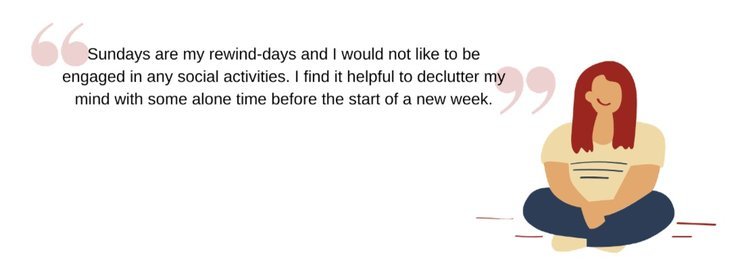
Avoid engaging in the subsequent feelings of guilt or shame of that boundary, you may waiver in that situation. Not following through with the consequences you’ve stated will reduce the respect one has for the boundary you’ve stated.
An example of delivering your boundaries assertively:
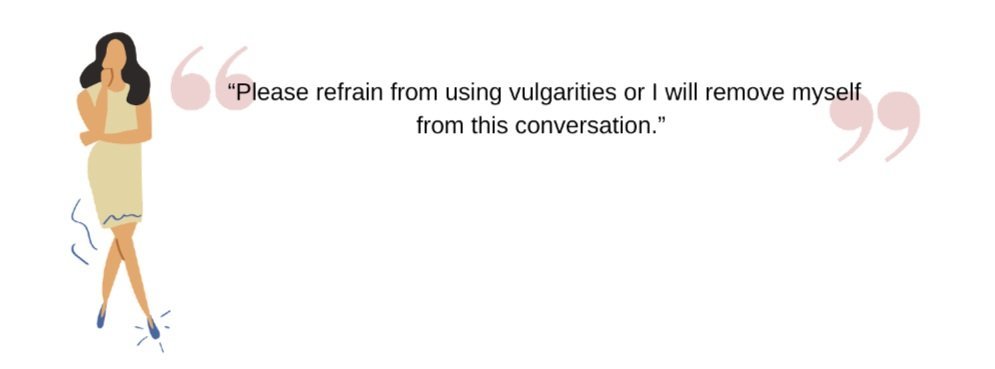
In this case, if individual still proceeds with vulgarities, leave the conversation instead of continuing to engage in the conversation.
We tend to subconsciously start off a sentence with “I’m sorry but…” when asking for help. It is completely normal to ask for help, so be confident about it. Your needs are as important as other people’s needs. Asking for help does not mean you are incompetent, but rather, a task could simply require additional clarification or it could be out of your area of expertise - this happens to even the best of us.
However, there are times where help may not readily come your way when you need them. Respectfully accept the “no” just like how you would like your “no” to be respectfully accepted and find someone else who can help you.
This may be difficult for some in fear of “looking bad” or “being viewed as lazy or not a team player”. However, as much it is important to help others, it should not be done at the expense of yourself. This is in not suggesting that you be selfish or self-centered, but to respect the boundaries of your personal time, personal capabilities, and what may be out of your control.
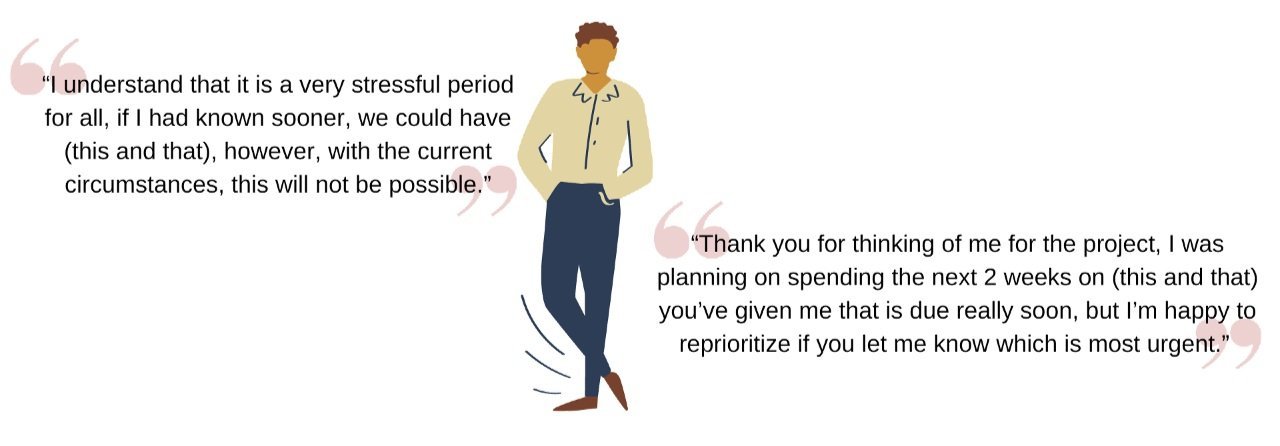
Saying “no” can be done assertively yet respectfully.
Examples of ways you can say “no” assertively yet respectfully:
6. Be in charge of your own needs
This will require you to understand what matters most to you. You know yourself best, including your needs. Avoid depending on others to meet your needs or to tell you what is best for you. Setting boundaries based on your own needs is in no way being selfish, but a form of self-love and self-care. Be fair to yourself and be mindful about putting yourself in avoidable situations that may end up being undesirable.
Establishing clear healthy boundaries may be uncomfortable for some, but remember that your needs matter too. Start off with those closest to you to build your confidence!
Credit: Millennials of Singapore
AWARE Sexual Assault Care Centre
6779 0282 (10AM to midnight, Mon-Fri)
KK Women's Hospital
6225 5554 (24 hours)
Singapore General Hospital
6222 3322
Tan Tock Seng Hospital
1800 7372 7500
Sexual assault is any unwanted sexual behaviour that makes a person feel uncomfortable, threatened or scared. Consent is key - if you did not consent to such behaviour, or withdrew your consent, and the other party continues to make unwelcome advances, that is sexual assault.
AWARE Singapore has also published a helpful resource on what sexual assault is.
No one has the right to violate you no matter how you dressed, or whether you are unconscious or not.
Try and remember as much as you can about your surroundings when the assault occurred; the smallest details can make a huge difference. At the earliest opportunity, try and picture the offender’s face, features or clothing (distinct colours, features or brands for example).
If you were unconscious during the assault, try to remember what you can of what occurred before and after you became unconscious or assaulted, including your surroundings. Find out if there was anyone around whom you can ask for more information of what happened.
In order to gather and preserve evidence, a sexual assault forensic examination (commonly referred to as “rape kit exam”) can be done at either KK Women’s Hospital, Singapore General Hospital or Tan Tock Seng Hospital within 72 hours of the incident – these hospitals are best equipped to deal with sexual assault.
You are required to make a police report before doing the rape kit exam. If you are under the age of 21, your parent or legal guardian is required for the rape kit exam.
Although it is strongly advisable to make a police report and undergo the rape kit exam, do not feel that you must do so against your will (or at the insistence of your family or friends) if doing so causes you great distress. This may only end up worsening your mental health. Instead, persuade your loved ones to respect your decision.
It is normal to feel strong emotions such as disgust or shame. Don’t avoid experiencing them.
Accepting that these feelings are unavoidable is the first step to managing what you are going through. When you are ready, open up about what happened to people you trust. In fact, keeping the fact of the assault all to yourself can be extremely suffocating.
There are countless testimonies published online (#MeToo movement) and support groups where survivors share their experiences – AWARE has one for female survivors (16 years of age and above) of sexual assault. You could hear from others on how they coped with their experiences. If you're not comfortable speaking to a group of people, you could share your story online anonymously with AimForZero or speak to a trusted friend. We all need an outlet somehow.
Sharing your experience and seeking comfort in the support of others can help you to cope with the debilitating incident. Here are some benefits of doing so:
Ψ Release pent up emotions
Ψ Receiving support from a support network (family, volunteers, welfare organisations)
Ψ Make sense of your thoughts and emotions
Ψ Greater clarity of what happened during the incident
Ψ One step closer to management
Ψ Spread awareness of this issue in society (without these small contributions, many others may continue to be oblivious)
Even if you really do not feel like confiding in someone, try and seek out at least one or two trusted confidants.
Acceptance (Not Avoidance!)
While it may be painful, recalling and accepting the incident is important. Avoidance only makes whatever you were avoiding more salient.
The harder you try to avoid it, the more likely that you will be reminded of it, or make it more salient in your head. Acceptance is not the same as blaming yourself for what happened. Rather, it includes being able to accept that what happened was out of your control.
Coping with Flashbacks
It is common to experience traumatic flashbacks. Prepare yourself by developing some awareness of possible triggers (e.g. certain smells). Once you are more aware of your triggers, it will help you make sense of what is happening and why.
During flashbacks, pay attention to physical sensations and what emotions you are feeling during these episodes. After, take steps to calm down, such as breathing exercises. Ground yourself in the present (e.g. tapping your arms, naming the current day) as this will help you realise that it is a flashback and not reality.
Don’t Isolate Yourself!
Stay connected with loved ones and join social activities. You don’t have to constantly talk about sexual assault or things related to it. You can do things that have nothing to do with the trauma itself.
If these activities bring you joy, they can be equally helpful. Participating in joyful activities isn’t avoidance. You can choose to accept that you are feeling low or down, and yet try to do something to lift your spirits.
Seek Professional Help
Sexual assault and trauma is linked to a bunch of mental disorders, depression, PTSD, anxiety disorders etc… If you feel unable to carry on with your everyday life due to the repercussions of the incident, seek help from a mental health professional.
Don’t blame them for whatever that has happened, pass judgments or express doubt on their story.
Be a listening ear. Listen to their narration of events, bearing in mind that effect of trauma may have had an adverse impact on their ability to accurately remember the relevant sequence of events.
Don’t downplay or trivialise the incident. This will (definitely) come across as doubting or invalidating their feelings. Let them feel whatever they must feel as part of their own process.
At an appropriate time, encourage them to seek help whenever they can (e.g. psychologists, counsellors), but let them do so on their own terms. Do not insist for them to seek help. Only encourage them to do so if it seems as though their distress is causing them to be unable to function daily or normally.
Provide emotional support whenever you can. A sexual assault experience can be extremely traumatic and effects can last for a long time. Think along the lines of “How can I be there for him/her?” rather than “What concrete steps do I need to take to help?”.
Tips/Precautions
Be mindful of your surroundings and the environment you are in. If necessary, take additional precautions if you have to walk in an unsafe area.
Do not assume that someone else will look out for your safety. In bars or at parties, keep your drink with you. Leaving your drink unattended makes it possible for someone to spike them with date rape drugs or intoxicating alcohol. Know your limits and keep within them, especially when it comes to drinking in unfamiliar places. Being surrounded by familiar people does not make a place “familiar”.
Sexual assault occurs even if you least expect it. Do not keep quiet if an assault is imminent. The shock may overwhelm and you may be too frightened, but always seek help immediately. Scream or shout for help if you have to.
How to contribute to the cause
Stay current on sexual assault laws. By educating ourselves on the many forms and types of sexual assault, when they can happen and what safety nets we have in place in society, we become more knowledgeable on the issue and can either help spread awareness, or strive for change in the community.
Become an advocate for sexual assault victims. You can start small – from sharing with your friends and family about your experiences (if any) and how you survived. You can volunteer for AWARE, join a movement or speak up about the issue whenever you can.
Know how to respond to sexual assault cases. For example, if a stranger approaches you for help or if you witness something happening, don’t be an apathetic bystander. Help the person. With people being more alert and informed, offenders will be more afraid to act out. Deterrence may not completely stop sexual assault, but it can at least reduce the number of cases and victims.
A suicide attempt is extremely traumatic.
Survivors feel disorientated, lost, not knowing where and how to go from here on. Others may feel intense waves of fear, sadness or anger. Some, after experiencing these waves, become seemingly emotionless. Numb. It is natural to have such feelings and thoughts.
Here is a list of steps to follow after a suicide attempt:
Call a loved one or trusted friend right away.
Our ability to actively care for ourselves are greatly affected by the circumstances that give rise to the attempt in the first place. Having survived the attempt, this ability is further compromised. Which means that you are going to need support. Reach out immediately.
After informing, go to the nearest hospital or medical clinic to seek medical attention. Even if the attempt does not result in you suffering from any physical injury however minor, you should still seek medical attention.
Knowing what to expect greatly reduces the anxiety that comes with waiting in a busy medical facility.
Firstly, emergency staff are trained to assess and manage any injuries requiring immediate medical attention. This is known as triage. After treating these injuries, they will then arrange for a mental health professional to meet and have a chat with you about your mental health status. This may include questions on your mood, the presence of recent major stressors, and any concerns with your daily functioning. This is really just to assess your mental state and look for any further risks that you may be facing.
Occasionally, the hospital may require a detailed review by doctors with different specialisations. Depending whether such doctor(s) are on hand, you may be warded for further observation or admitted into a ward.
We often do not realise how many members of our tribe (your family, friends, colleagues, peers - anyone who is a part of your larger network) actually do care about our safety and well-being. Even if you don’t ordinarily consider them to be part of your support network.
It’s common for people to worry over what to say to others after the attempt. You may want to start a conversation only after you feel comfortable enough to share about your experience, and even then, you can control how much you want to share. Confiding in a support group that you trust and feel connected to helps you process the experience and suicidal thoughts, or make these thoughts easier to manage if they return.
You may find it helpful to write down thoughts and helpful tips to make your transition period easier (“journalling”, for example). These include things like knowing what you can do to make it easier to cope with things in the days following your discharge from the hospital, knowing who in your social support network you can reach out to, and most importantly, having a plan for dealing with suicidal thoughts should they come up again.
Most importantly, seek support from a mental health or counselling professional if you feel suicidal. They will work together with you to create a safety plan or finding ways to cope. Things can change for the better if you allow it to.